
Menu
latest blog
Lorem ipsum dolor sit amet, consectetur adipiscing elit. Ut elit tellus, luctus nec ullamcorper mattis, pulvinar dapibus leo.

The Ultimate PCB Material Guide: Balance Performance, Cost & Credisyn CCL
The Printed Circuit Board (PCB) is no longer just a structural platform that holds components together; it is an active component in the electronic circuit. In the era of 5G connectivity, Electric Vehicles (EVs), and High-Performance Computing (HPC), the substrate material—the Copper Clad Laminate (CCL)—dictates the speed, thermal endurance, and reliability of the final device.
Choosing the wrong material can lead to catastrophic failures: signal attenuation in high-speed servers, thermal runaway in LED lighting, or delamination in automotive radar systems. Conversely, over-specifying a material can destroy a project’s profit margins.
At Credisyn, we produce the foundational materials that power modern electronics. From standard FR-4 to advanced Metal Core and High-Frequency laminates, we understand the physics behind every sheet. This guide is designed to help PCB designers, engineers, and procurement managers navigate the complex landscape of PCB material selection.
1. The “Big Three” Properties: Understanding the Datasheet
Before diving into specific material types, one must understand the language of the laminate datasheet. When you look at a Credisyn technical specification sheet (IPC-4101 compliant), three categories of properties govern your decision: Electrical, Thermal, and Mechanical.
A. Electrical Properties: The Signal Highway
For high-speed and RF designs, electrical properties are paramount.
- Dielectric Constant (Dk or $\varepsilon_r$):
- Definition: This measures how much charge the material can store relative to a vacuum. It affects impedance and signal propagation speed.
- The Rule: Lower is generally better for high speed. Signal velocity is inversely proportional to the square root of Dk ($v \approx c / \sqrt{Dk}$).
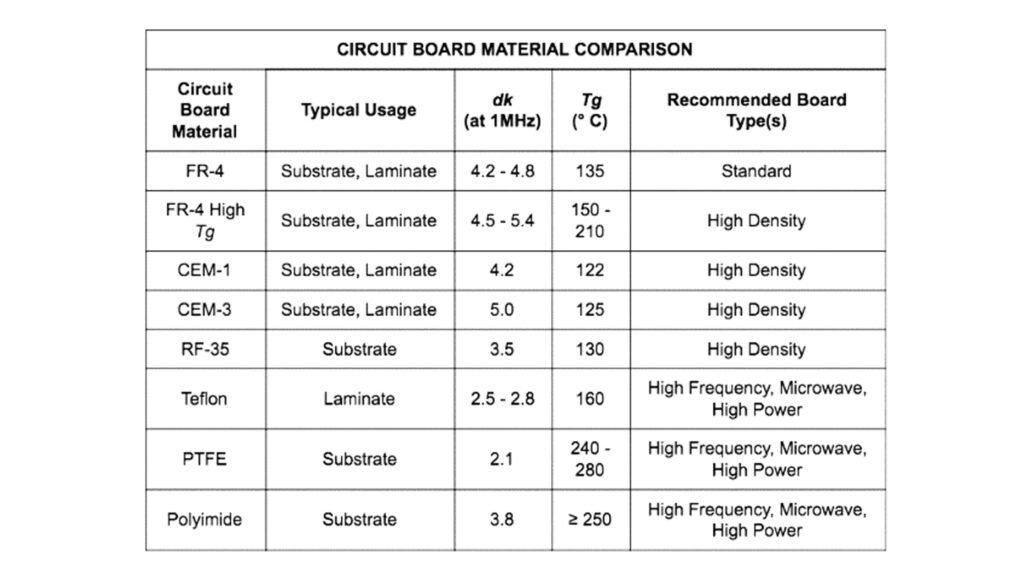
- Credisyn Insight: Standard FR-4 has a Dk of ~4.4. For our 5G/6G High-Frequency Series, we engineer materials with Dk values as low as 2.2 to 3.0, utilizing advanced resin systems like Cyanate Ester or PPO to ensure signals travel near the speed of light.
- Dissipation Factor (Df or $\tan\delta$):
- Definition: This measures how much signal energy is lost as heat within the dielectric material.
- The Rule: Lower is critical for signal integrity.
- Categories:
- Standard Loss: Df ~0.02 (Standard FR-4). Good for <1GHz.
- Mid Loss: Df ~0.01. Good for 1-5GHz.
- Low Loss: Df ~0.005. Good for 10GHz.
- Ultra-Low Loss: Df <0.002. Required for 25GHz+ and Automotive Radar.
- Credisyn Insight: Our specialized “Low-Loss” laminates use “Flat Glass” fabric styles (like 1067 or 1078) to minimize the “Fiber Weave Effect,” ensuring consistent Df across the entire board.
B. Thermal Properties: Handling the Heat
As components shrink and power densities rise, the material must survive the heat of operation and the heat of assembly (soldering).
- Glass Transition Temperature (Tg):
- Definition: The temperature range where the polymer matrix changes from a hard, glassy state to a soft, rubbery state.
- The Danger: Above Tg, the material expands rapidly (high CTE), putting stress on copper vias.
- Selection:
- Standard Tg (130-140°C): Consumer electronics, toys, simple controllers.
- Mid Tg (150-160°C): Industrial controls, general computing.
- High Tg (170°C+): Automotive, Multilayer boards (>10 layers), Heavy Copper applications.
- Decomposition Temperature (Td):
- Definition: The temperature at which the material loses 5% of its weight due to chemical breakdown.
- Credisyn Standard: Most of our High-Tg materials feature a Td > 340°C, ensuring they survive lead-free solder reflow profiles (which peak around 260°C) without carbonizing.
- Coefficient of Thermal Expansion (CTE):
- Definition: How much the material expands when heated. Measured in ppm/°C.
- The Critical Axis: The Z-axis CTE is the PCB killer. If the laminate expands faster than the copper barrel in a plated through-hole (PTH), the copper cracks, causing an open circuit.
- Credisyn Solution: We utilize silica fillers and specialized curing agents to keep Z-axis CTE < 2.5% (50-260°C).
C. Mechanical Properties: Durability
- Peel Strength: The force required to rip the copper foil off the dielectric. Important for fine-line etching. Credisyn standard: >1.2 N/mm (for 1oz copper).
- Moisture Absorption: Water is the enemy. If a PCB absorbs moisture and is then heated to 260°C (reflow), the water turns to steam and explodes the board (Delamination/Popcorn Effect). Credisyn maintains moisture absorption <0.15%.
2. Material Categories: Matching Material to Application
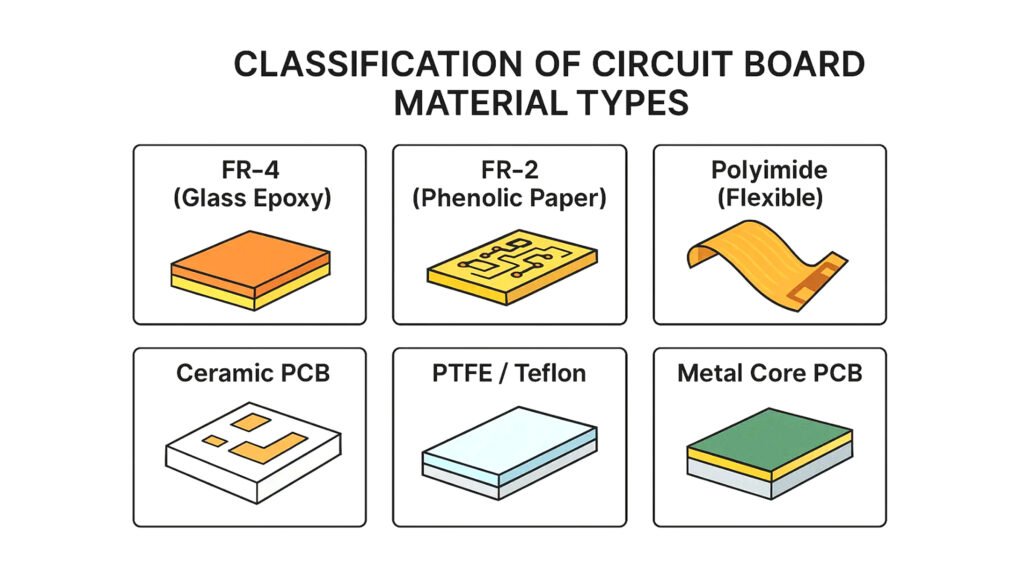
Credisyn manufactures a wide spectrum of laminates. Here is how to select the right category for your project.
Category 1: Standard & High-Tg FR-4 (Epoxy/Glass)
Best For: 80% of global electronics. Consumer goods, industrial controllers, IoT devices.
- Composition: Woven E-glass cloth impregnated with epoxy resin.
- The Upgrade: For lead-free soldering processes (RoHS compliant), always specify High-Tg (Tg >170°C) material with Phenolic-cured resin systems rather than Dicyandiamide (Dicy) cured. Phenolic systems offer superior thermal resistance (T260/T288).
- Credisyn Recommendation: Use our CS-FR-170 series for any multilayer board > 4 layers to ensure dimensional stability.
Category 2: Halogen-Free (Green Materials)
Best For: Smartphones, Tablets, European Market (RoHS/REACH strict compliance).
- The Tech: Traditional FR-4 uses Bromine for flame retardancy. Halogen-Free (HF) materials use Phosphorus and Nitrogen compounds.
- The Bonus: HF materials actually have lower CTE and lower Dk than standard FR-4, making them excellent for reliability.
- Credisyn Recommendation: CS-HF-150. This series is not just eco-friendly; it offers a harder resin matrix that improves drilling accuracy for HDI (High Density Interconnect) designs.
Category 3: Metal Core / IMS (Insulated Metal Substrate)
Best For: LED Lighting, Power Converters, Automotive Headlamps, EV Battery Modules.
- The Problem: Standard FR-4 acts like a thermal blanket (Thermal Conductivity ~0.3 W/m·k). It traps heat.
- The Solution: Aluminum or Copper base laminates.
- Credisyn Options:
- CS-AL-2000 (Entry): 1.0 – 2.0 W/m·k. Perfect for commercial LED strips. Uses 5052 Aluminum alloy.
- CS-AL-4000 Ultra (High Perf): 3.0 – 8.0 W/m·k. Uses specialized nano-ceramic filled dielectric (Alumina/Boron Nitride). Essential for high-power COB (Chip-on-Board) LEDs and automotive matrix headlights.
- Dielectric Thickness: Choose thinner dielectrics (50μm – 75μm) for better heat transfer, but ensure they pass the Hi-Pot Test (Breakdown Voltage > 3000V).
Category 4: High-Frequency / High-Speed (Low Loss)
Best For: 5G Base Stations, Automotive Radar (77GHz), AI Servers.
- The Tech: Standard Epoxy is replaced or modified with PPO (Polyphenylene Oxide), PTFE (Teflon), or Hydrocarbon resins.
- Copper Matters: At high frequencies, the “Skin Effect” forces electrons to travel on the outer surface of the copper. If the copper surface is rough (to help adhesion), the signal has to travel a longer path over the “peaks and valleys,” slowing it down.
- Credisyn Recommendation: Specify HVLP (Hyper Very Low Profile) copper foil with our Low-Loss Series. This smooth copper minimizes signal attenuation.
Category 5: CEM (Composite Epoxy Material)
Best For: Single-sided PCBs, Household Appliances (White Goods), Cost-sensitive LED.
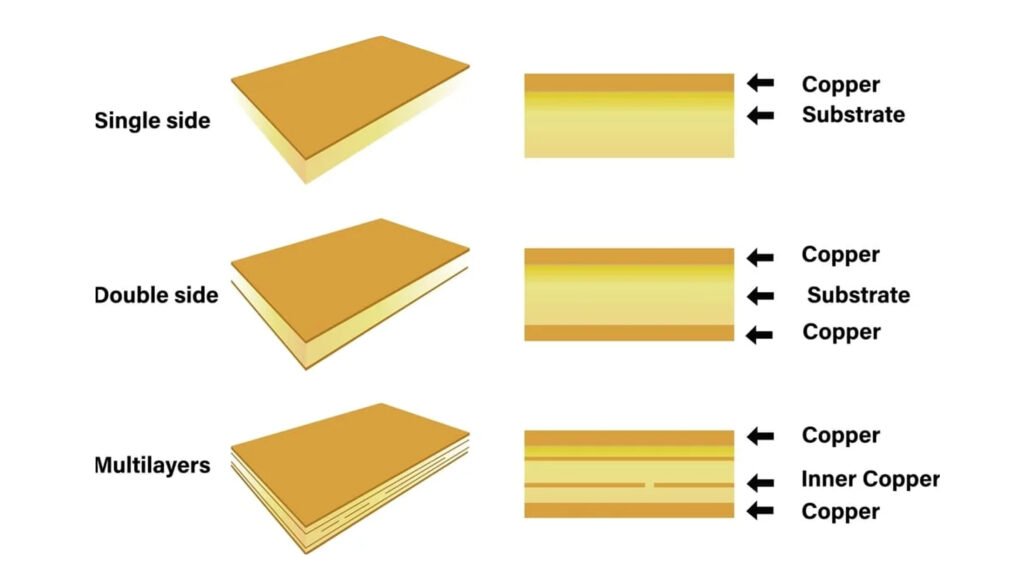
- CEM-1: Paper core / Glass surface. Cheap, punchable. Good for remote controls.
- CEM-3: Felt glass core / Woven glass surface. A cheaper alternative to FR-4 for double-sided boards.
- Credisyn Insight: Our CEM-3 offers a thermal conductivity slightly better than FR-4 and is excellent for high-volume, cost-sensitive manufacturing like LED light bulbs.
3. Case Studies: The Cost of Wrong Selection vs. The Value of Right Selection
To illustrate the importance of material selection, let’s look at two scenarios from Credisyn’s client history.
Case A: The “Popcorn” Failure (Automotive Dashboard)
- The Scenario: A Tier-1 automotive supplier was building a dashboard display unit.
- The Mistake: To save costs, they selected a “Standard Tg” (135°C) FR-4 material.
- The Process: The board went through three reflow cycles (Side A, Side B, and a connector assembly).
- The Result: During the third reflow, the accumulated thermal stress caused the moisture trapped inside the laminate to expand. Because the resin was soft (above its Tg), the vapor pressure delaminated the layers. 15% of the batch failed at the End-of-Line tester.
- The Fix: Credisyn recommended switching to CS-FR-170 (High Tg) with “Low Moisture Absorption” chemistry.
- Outcome: Defect rate dropped to 0%. The material cost increased by 8%, but the total production cost decreased by 12% due to eliminated scrap.
Case B: The 5G Signal Loss (Telecom)
- The Scenario: A manufacturer of 5G micro-cells used a standard FR-4 material for the antenna board.
- The Mistake: They focused on Dk (Impedance) but ignored Df (Loss). Standard FR-4 has a Df of 0.02.
- The Result: At 3.5 GHz (Sub-6GHz 5G), the signal attenuation was so high that the transmission range was reduced by 40%. The amplifiers had to work harder, overheating the unit.
- The Fix: Credisyn supplied a Mid-Loss Laminate (Df 0.008) utilizing a modified epoxy resin.
- Outcome: Signal range met the specification, and thermal load was reduced.
4. Design for Manufacturability (DFM): Material Impact on Fabrication
Selecting a material isn’t just about the end-use; it’s about whether the PCB factory can build it. As a CCL manufacturer, Credisyn works closely with PCB fab houses to ensure our materials are process-friendly.
1. Drill Smear and Desmear
When drilling holes in High-Tg materials, the friction creates immense heat. If the resin is too brittle, it cracks. If it’s too soft, it smears over the internal copper connections (Smear).
- Credisyn Tech: We optimize the “Degree of Cure” in our prepregs. Our High-Tg resins are formulated to produce distinct chips during drilling rather than melting, reducing the need for aggressive Desmear chemical attacks (Permanganate).
2. Dimensional Stability (Warpage)
Materials shrink after etching (removing copper releases tension) and after lamination.
- The Hybrid Problem: Designers often mix materials (e.g., High Frequency layer on top of FR-4 core). If the CTE of these materials is different, the board will bow or twist like a potato chip during reflow.
- Credisyn Advice: When designing hybrid stacks, choose materials with matched CTE values (X/Y axis). Credisyn offers “Hybrid-Compatible” FR-4 that matches the expansion curves of common Rogers/Taconic equivalents.
3. Prepreg Flow and Fill
For boards with heavy copper (e.g., 3oz or 4oz), the prepreg (B-Stage) must flow enough to fill the gaps between the thick copper tracks without leaving voids.
- Credisyn Solution: We offer “High Flow” and “Low Flow” (for rigid-flex) prepreg options. For heavy copper, we recommend our CS-High-RC% (Resin Content) prepregs to ensure complete encapsulation.
5. The Future: Trends in PCB Materials
The market is moving fast. Here is what Credisyn is developing in our R&D labs to meet future demands (2025-2030).
A. Ultra-Thin Dielectrics for HDI
As smartphones pack more tech into smaller spaces, “Any-Layer HDI” is becoming standard. This requires dielectric layers as thin as 25μm to 40μm.
- Challenge: Making a 25μm layer that doesn’t tear during handling.
- Solution: Using Ultra-Fine Glass Fabrics (1010, 1017 styles) and toughened resin systems.
B. Glass-Free Laminates
For the ultimate signal integrity in 6G (Terahertz frequencies), the glass weave itself causes interference (Skew).
- Solution: Uniform film dielectrics or “Spread Glass” where the fibers are mechanically flattened to eliminate gaps.
C. Thermal-Electrical Paradox
The industry wants materials that conduct heat (Thermal Conductivity) but stop electricity (Dielectric Strength).
- Innovation: Credisyn is experimenting with Nano-Boron Nitride (BN) fillers. Unlike Alumina (Al2O3), BN offers superior thermal transfer without compromising the electrical insulation, pushing standard FR-4 thermal conductivity from 0.3 to 1.0+ W/m·k.
6. The Credisyn Material Selection Checklist
Before ordering your next batch of CCL or specifying a PCB, use this 10-point checklist to ensure you have the right material.
- Operating Frequency: Is it <1GHz (Standard FR-4), 1-10GHz (Mid-Loss), or >10GHz (Low-Loss/PTFE)?
- Max Operating Temperature: What is the ambient temp + component heat rise? Keep this 20°C below the material’s Tg.
- Voltage Requirement: High voltage (>500V)? Check the CTI (Comparative Tracking Index) rating. Require CTI > 600V (PLC 0).
- Thermal Management: Are there high-power LEDs or MOSFETs? Consider Aluminum Base (IMS) or Heavy Copper.
- Mechanical Stress: Will the board be subjected to vibration (Automotive/Aerospace)? High Peel Strength and Flexural Strength are needed.
- Stack-Up Complexity: Is it >8 layers? Use High-Tg / Low-CTE material to prevent Z-axis expansion failures.
- Environment: Harsh environment? Check for “Anti-CAF” (Conductive Anodic Filament) resistance grades.
- Form Factor: Rigid, Flex, or Rigid-Flex? Ensure material compatibility (e.g., No-Flow Prepreg for rigid-flex bonding).
- Regulatory: Need UL V-0? RoHS? Halogen-Free? (Credisyn standard is V-0).
- Cost Target: Do not over-spec. Don’t use a spaceship material for a coffee maker. Consult Credisyn for the “Sweet Spot” material.
Conclusion: Partnering for Precision
There is no “perfect” PCB material—only the perfect material for your specific application.
At Credisyn, we do not just manufacture Copper Clad Laminates; we engineer the substrate of the future. Our production lines, capable of producing millions of square meters annually, are tuned to deliver consistency, from the grain structure of the copper foil to the cross-linking density of the resin.
Whether you are designing a cost-sensitive IoT sensor or a mission-critical EV Battery Management System, Credisyn has the formulation and the expertise to support you.
Ready to select the right foundation for your electronics? Contact our Technical Application Group (TAG) today for a consultation on your stack-up and material needs. Let’s build reliability together.
Application
Recommended Series
Key Feature
Tg (°C)
Consumer / Generic
CS-FR-140
Cost-effective, Stable
135-145
Industrial / Multilayer
CS-FR-170
High Reliability, Anti-CAF
170-180
Mobile / Green Tech
CS-HF-150
Halogen-Free, Eco-friendly
150-160
LED Lighting
CS-AL-2000
Aluminum Base, 2.0 W/m·k
N/A
Auto Headlamps
CS-AL-4000 Ultra
Aluminum Base, 4.0 W/m·k
N/A
5G / AI Servers
CS-HighSpeed
Low Dk/Df, Flat Glass
200+
EV Power / Heavy Cu
CS-Heavy-600
High CTI, Thick Copper
180+
(Note: Data representative of typical values. Please refer to specific Credisyn Datasheets for engineering calculations.)
Paper core copper-clad substrate
Glass cloth copper-clad substrate
Cloth paper composite copper-clad substrate
Cloth felt composite copper-clad substrate
Paper core copper-clad substrate
Glass cloth copper-clad substrate
Cloth paper composite copper-clad substrate
Cloth felt composite copper-clad substrate
Credisyn quality copper clad laminates for global electronics
Credisyn-Professional CCL manufacturer, delivering reliable electronic substrate solutions worldwide.
Quick Link
Email: info@credisyn.com
Quick Link
Add: No. 18 Hong Kong Middle Road, Qingdao, China
Copyright © 2025 Website Title Copper Cladd Laminated Supported by Credisyn technology